

Lately I keep hearing the same sentence from women who had DCIS or are at an increased risk for breast cancer: “Well, I’m on Duavee.”
When I ask why, the answer usually traces back to one study and one number. The number is Ki-67. It went down, so the drug must be safe. Maybe even protective.
I understand why that feels reassuring. But a drop in Ki-67 is not the same as a cancer that shrinks, stays away, or never comes back. And if medicine is going to use Ki-67 to steer decisions for women, it has to use it the same way every time.
So let’s talk about what Ki-67 actually is, what it can tell us, and where medicine has stretched it further than the evidence goes.
What You’ve Probably Been Told
If you’ve had a breast biopsy, you may have seen Ki-67 on your pathology report. It’s usually explained something like this:
“A high Ki-67 means your cancer is fast-growing.”
“Your Ki-67 dropped, so the treatment is working.”
“Estrogen raises Ki-67, so estrogen feeds cancer.”
Each one says more than the test can say. To see why, we have to start with the cell cycle.
First, the Cell Cycle
Your cells don’t divide on a whim. They move through a careful set of steps called the cell cycle.
Resting (G0). The cell is doing its normal job and is not getting ready to divide. Most healthy cells spend most of their time here.
Getting ready (G1). The cell grows and checks whether conditions are right.
Copying (S). The cell makes a copy of its DNA.
Double-checking (G2). The cell checks that copy for mistakes.
Dividing (M). The cell splits into two.
Between these steps are checkpoints. Think of them as quality-control stations. At each one, a cell can keep going, pause to fix damage, or shut itself down if the damage is too great.
That means a cell can enter the cycle and never finish dividing. It might stop to repair. It might die. Entering the cycle is not the same as making a new cell.
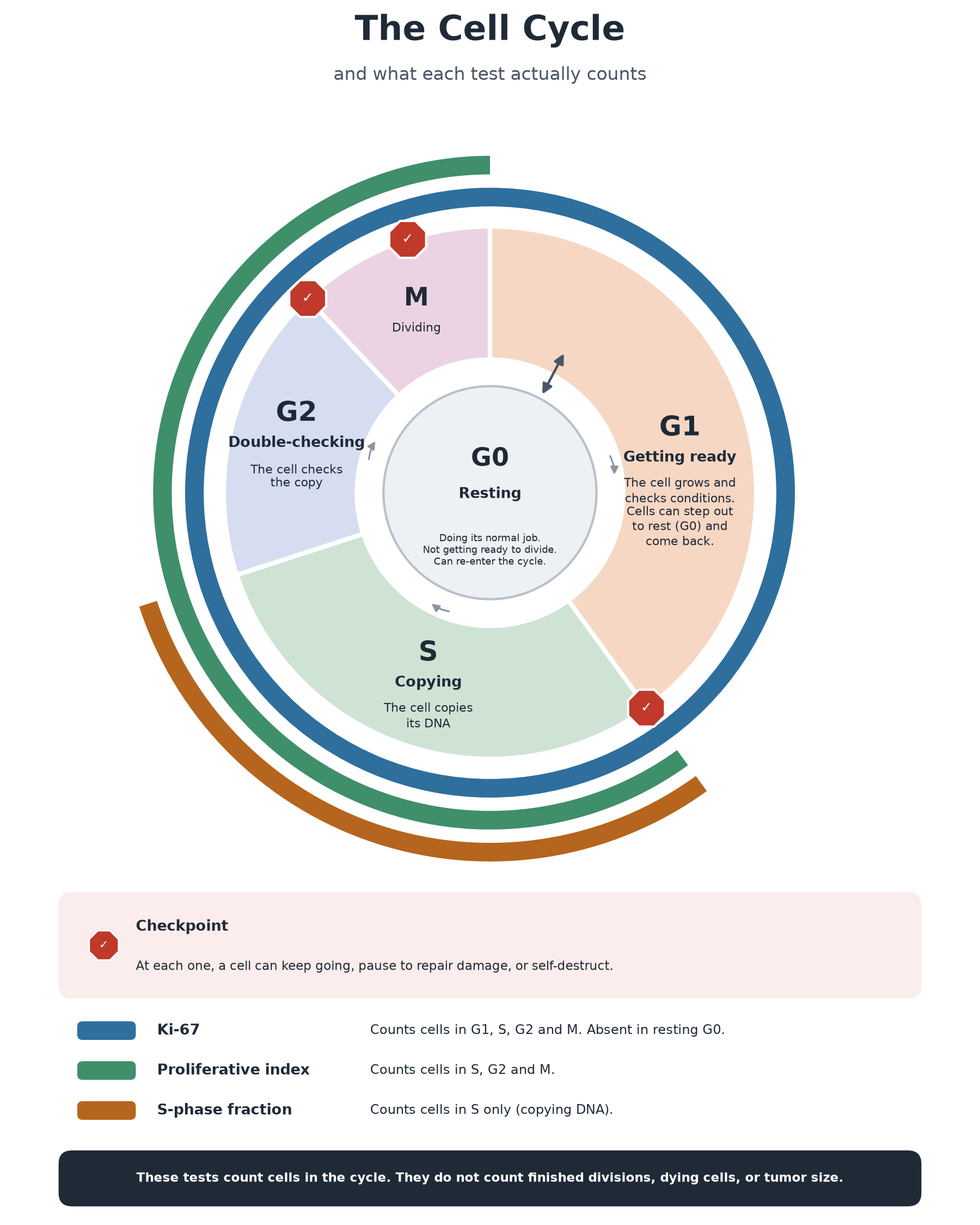
You’ll see three tests in breast cancer research. They all look at the same cycle, but they count different parts of it. S-phase fraction counts only cells copying their DNA. Proliferative index counts cells in the copying, double-checking and dividing steps. Ki-67 counts every cell that has left the resting stage. None of them count finished divisions, dying cells or tumor size.
So What Is Ki-67?
Ki-67 is a protein inside the center of the cell, called the nucleus. Cells make it once they leave the resting stage and enter the cycle. Resting cells don’t have it [1].
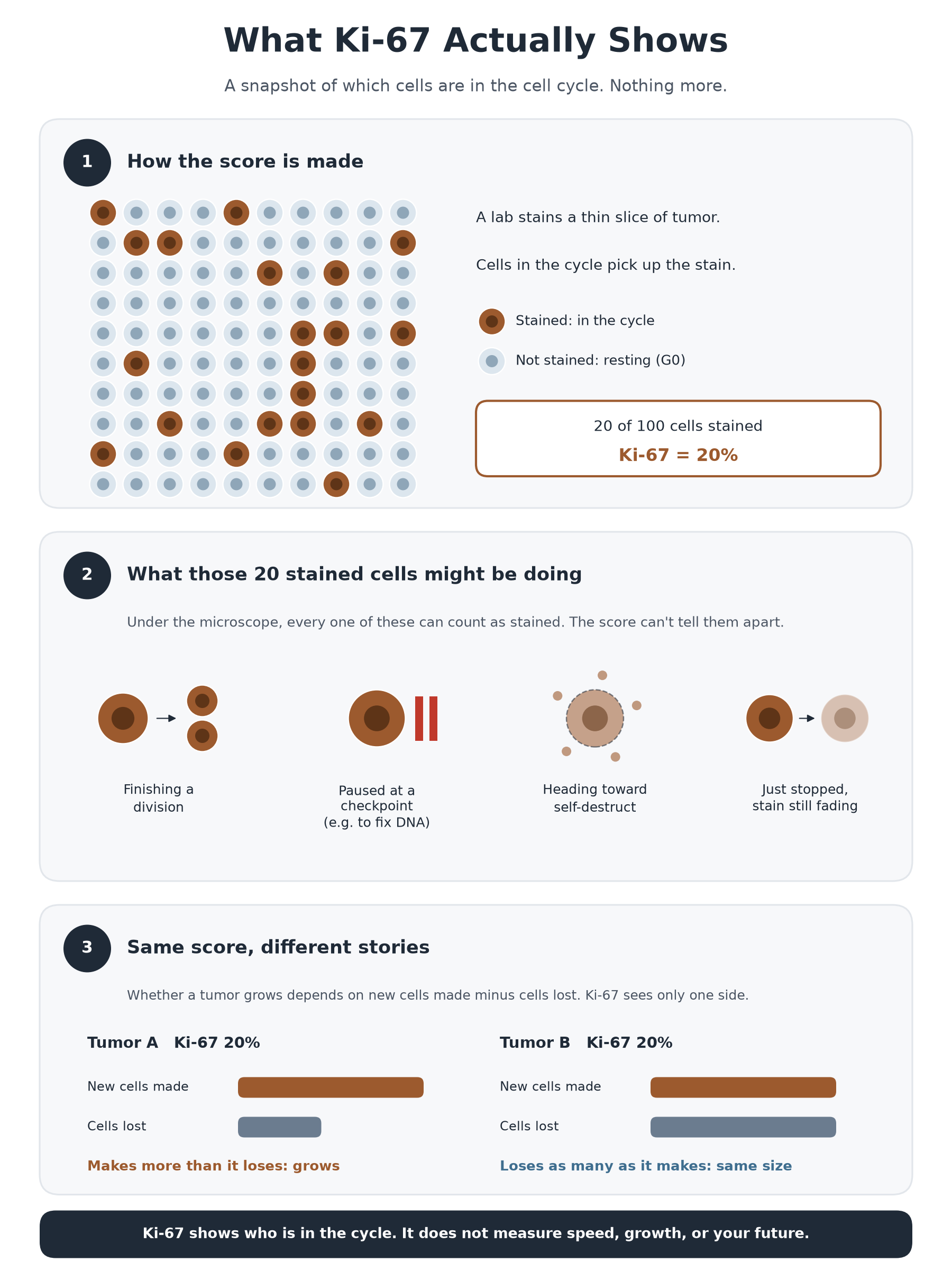
To get a Ki-67 score, a lab stains a thin slice of tumor and counts. Out of every 100 cancer cells, how many picked up the stain? If 20 out of 100 did, the score is 20%.
Here’s how I often explain it to women.
Picture a teddy bear factory. Each bear moves down a conveyor belt in steps. It gets cut out. It gets stuffed. It gets sewn shut. Then it passes an inspector before it goes in a box.
The inspector checks every bear. If a seam is loose, the bear gets pulled aside and sewn again. If the bear is ripped beyond repair, it gets thrown out. Some bears just sit on the belt for a while because the line has stopped.
Now imagine you snap one photo of the factory floor. Out of 100 bears in the building, 20 are on the belt. That’s your Ki-67 score: 20%.
That photo tells you how many bears were on the line. That’s it. It doesn’t tell you:
How many bears actually got finished and boxed
How many got pulled aside for repair
How many got thrown away
How many were just sitting there, stuck
How fast the belt was moving
Your cells work the same way. The inspectors are the checkpoints I talked about earlier. A cell can enter the cycle, stop to fix damaged DNA, or get scrapped before it ever becomes two new cells. Ki-67 counts the bears on the belt, not the bears in the box.
It’s also a snapshot, not a video. Ki-67 breaks down slowly, so a cell that has just stopped cycling can still test positive for a while [2].
And the Ki-67 score depends on where the sample came from. A tumor isn’t the same all the way through. One spot can have more cells on the belt than another.
The type of sample matters too. Most women with breast cancer have two samples taken. The first is a needle biopsy. A thin needle pulls out a small strip of the tumor to find out if it’s cancer. The second comes later, when the tumor is removed in surgery.
Those two samples aren’t handled the same way. A needle sample is tiny, and it goes into a preserving liquid right away. A surgery sample is much bigger. It can sit longer before that liquid soaks all the way into the center, where the tumor is. That delay can change how the cells pick up the stain [3].
We know this from a large trial called POETIC. It included 4,480 women after menopause with ER-positive breast cancer. Two out of every three got an aromatase inhibitor (anastrozole or letrozole) for 2 weeks before surgery and 2 weeks after. These drugs block the body from making estrogen. The rest got no treatment around surgery. No estrogen blocker. No other drug. Nothing [3].
The researchers looked at 679 of the women who got no treatment. They compared Ki-67 from the first needle biopsy with Ki-67 from a second sample taken about 2 weeks later. When the second sample was another needle biopsy, Ki-67 barely moved. It dropped about 4%. When the second sample came from surgery, Ki-67 dropped about 18% [3].
Nothing was done to the cancer. The sample changed. The researchers called this kind of drop “artefactual.” That means it comes from the testing, not the tumor [3].
Keep that in mind, because nearly every study below compares a needle biopsy to a surgery sample.
Dr. Zsuzsanna Suba, a pathologist whose work has shaped so much of how I think about estrogen, put it simply when I asked her about this. She sees Ki-67 as a very good sign of how active the cells are in a sample. But it can be different in different parts of the same tumor, and it doesn’t decide anything on its own.
What Ki-67 Can and Can’t Tell You
Ki-67 isn’t useless. In large groups of women, a higher score goes along with a higher chance of the cancer coming back. An international group of experts who study this test says it’s most useful for one job: estimating outlook in early-stage ER-positive, HER2-negative breast cancer. Even then, they only trust very low scores (5% or under) or very high ones (30% or more). Everything in between is a gray zone [1].
Here’s what Ki-67 can’t tell you:
How fast the cells are dividing
Whether the cells finish dividing
How many cells are dying
Whether the tumor is growing or shrinking
Whether cells are repairing their DNA
Why the number changed
What will happen to you
Hold onto that list. Now let’s look at the studies.
Study 1: PROMISE and Duavee
Duavee is a pill that combines two things. One is conjugated estrogens, a mix of estrogens taken from the urine of pregnant horses. The other is bazedoxifene, a drug that blocks estrogen’s effects in breast and uterine tissue.
The PROMISE trial gave postmenopausal women either Duavee or a placebo (a sugar pill) for about four weeks before surgery. Every woman had ER-positive DCIS. DCIS stands for ductal carcinoma in situ. It means abnormal cells that are still inside the milk ducts and haven’t spread into the tissue around them. Ninety-four women had Ki-67 measured before and after: 46 on Duavee and 48 on placebo [4].
Here’s what happened. Ki-67 fell by an average of 5.62 percentage points with Duavee and 1.07 points with placebo. That difference was statistically significant. Hot flashes improved with Duavee, but quality-of-life scores didn’t change [4].
Here’s the part that matters. From that Ki-67 drop, the authors wrote that Duavee could be considered “a safe option” for women concerned about breast cancer, and that it “may reduce the risk of developing invasive breast cancer” [4].
Did the study show that? No. It measured Ki-67 over about four weeks. It did not measure invasive cancer, recurrence, or survival. That word “may” is doing a lot of work.
There’s more. Duavee’s own FDA label lists a past history of breast cancer as a reason not to use it [5]. So “Duavee for everyone with breast cancer” isn’t backed by outcome studies, and it isn’t what the label says either.
And we don’t even know which part of the pill lowered Ki-67. Duavee contains an estrogen. Was it the blocker? The estrogen? Both? The study wasn’t designed to tell us.
Study 2: PRESTO and Estradiol
Now for the study that didn’t get the headlines.
In PRESTO, 19 postmenopausal women with newly diagnosed, low-grade, ER-positive, HER2-negative breast cancer took estradiol, 6 mg a day, for 7 to 14 days before surgery. These women were at least five years past menopause and had not been taking estrogen [6].
Ki-67 dropped in 13 of the 19 women. Using the authors’ method of averaging (a geometric mean), Ki-67 fell 38.7% [6].
The researchers then looked at which genes turned on and off. They found a pattern pointing to something called the DREAM complex. DREAM is a group of proteins that works like a parking brake on the cell cycle. When it’s switched on, it holds cells in a quiet, resting state that can be reversed later [6].
In other words, in these tumors, estradiol looked like it was helping cells rest, not pushing them to divide. The researchers also found no sign that the estradiol was killing cells off [6]. The drop in Ki-67 looked more like cells settling down.
The authors are careful, and I want to be too. They call this “hypothesis generating only.” There was no comparison group. It was 19 women with low-grade tumors [6].
So here’s my question.
PROMISE found a drop in Ki-67 with Duavee, in DCIS, and the message became “may reduce the risk of invasive breast cancer.” PRESTO found a drop in Ki-67 with estradiol, in women who actually had invasive breast cancer. Where was the same excitement?
I’m not saying PRESTO proves estradiol is safe after breast cancer. It doesn’t. Neither study tells us anything about recurrence. What I’m saying is this: if a Ki-67 drop is enough to call Duavee “a safe option,” then estradiol deserves the same conversation. We can’t hold one standard for a drug and a different standard for a hormone.
Study 3: WinPro and Progesterone
The WinPro trial, published in 2026, studied micronized progesterone in women with early ER-positive, PR-positive, HER2-negative breast cancer that was still present before surgery. Micronized progesterone is the same molecule your ovaries make. It is not a synthetic progestin.
Two hundred forty-four postmenopausal women were enrolled. For 14 days before surgery, they took letrozole alone, letrozole plus micronized progesterone, or tamoxifen plus micronized progesterone. The main comparison was between the two letrozole groups [7].
Among the 189 women who completed treatment as planned, Ki-67 suppression was 88.2% with letrozole alone and 89.2% with letrozole plus micronized progesterone. There was no significant difference between the two [7].
The study was hoping progesterone would push Ki-67 down even further. It didn’t. But it also didn’t get in the way. And women taking letrozole plus progesterone appeared to have fewer hot flashes: 13.3%, compared with 22.4% on letrozole alone [7].
I have to apply the same honesty here that I’m asking for everywhere else. “No difference found” isn’t the same as “proven identical.” And 14 days can’t tell us about recurrence or survival. What WinPro does is take away one common reason women are told progesterone is off the table.
Study 4: POETIC, the Real Test
The big question is this: when a drug lowers Ki-67, do fewer women have their cancer come back?
Remember POETIC, the trial with 4,480 women? It’s one of the few trials large enough to answer that question [8].
The aromatase inhibitor lowered Ki-67 a lot. In women with HER2-negative cancer, the typical drop was about 79% [3].
Then the researchers followed the women for about five years. The cancer came back in 280 of 2,976 women who got the drug (9%) and 154 of 1,504 women who didn’t (10%). That difference was not significant [8]. In the authors’ words, the treatment “has not been shown to improve treatment outcome” [8].
A big drop in Ki-67. No meaningful change in recurrence.
Ki-67 did sort women into groups, though. Among HER2-negative women who got the drug, those whose Ki-67 stayed high had a 21.5% chance of recurrence at five years. Those whose Ki-67 was low before and after had a 4.3% chance [8]. So Ki-67 told us something about how each tumor behaves. It did not show that pushing the number down changes what happens next.
Ki-67 Goes Down in Every Direction
Here’s what really stuck with me when I lined these studies up.
In one 2003 study, 125 women stopped their hormone therapy when they were diagnosed. Over about 17 days, their average Ki-67 fell from 16.5 to 11.5 [9].
So Ki-67 went down when women stopped hormones. It went down with Duavee. It went down with estradiol. It went down with an aromatase inhibitor. And it reads lower on surgery samples even when no drug is given at all [3].
If almost everything lowers Ki-67, then a lower Ki-67, by itself, can’t tell us which choice is best for a woman.
Dr. Suba reads the aromatase inhibitor results differently from mainstream oncology. In her view, the drop in Ki-67 on these drugs is a short-term response. She believes cancer cells push back by turning up their estrogen signaling, and that push can wear out over time. It’s another reminder that the same number can be read more than one way.
We’ve Seen This Before
Medicine does this a lot. We find a number we can measure, and we start treating the number as if it were the outcome.
Cholesterol is a good example. Lowering cholesterol is a number. A heart attack is an outcome. They don’t always line up.
A drug called torcetrapib raised “good” HDL cholesterol by 72% and lowered “bad” LDL cholesterol by 25%. On paper, it looked like a win. The trial was stopped early because more people died: 93 deaths with the drug, compared with 59 without it [10].
And in a study of 136,905 hospital stays for heart disease, almost half the patients came in with LDL cholesterol under 100, a level often called good. A "good" cholesterol number didn't keep them out of the hospital. That doesn't mean cholesterol never matters. It means a better number doesn't automatically mean fewer heart attacks. The only way to know is to count the heart attacks. [11].
A number is a clue. It isn’t the destination. When we start prescribing to the clue, women can end up on medications that make a lab value look better without any proof that they live longer or better.
What Women Deserve
Women deserve to know what a number on their report can and can’t say.
They deserve to know that Ki-67 shows which cells have entered the cell cycle, not how fast a tumor grows or whether it will come back. They deserve to know that a drop in Ki-67 has been used to promote some treatments and ignored for others. And they deserve the same standard of evidence for a hormone as for a drug.
If you’re on Duavee, you made a choice with the information you were given. Now you have a little more. Bring these questions to your next visit:
What outcome studies show this treatment lowers my chance of recurrence?
What was measured in the study you’re relying on: Ki-67, or recurrence and survival?
If a Ki-67 drop is enough for this drug, why isn’t it enough to talk about estradiol or progesterone?
What are the risks of not using hormones at all, for my bones, heart, brain, and quality of life?
You’re allowed to ask. You’re allowed to want the whole picture.
Want to Learn More?
Read my related articles on estrogen and breast cancer:
Besides Endocrine Therapy, What Are My Options? Start With Why the Cancer Grew in the First Place
Could There Be Another Explanation? Rethinking Estrogen, Endocrine Therapy, and Breast Cancer
Nobody Has Watched It Happen: What We Really Know About Cancer Cells “Waking Up”
The Minority Benefit: Why Hormone Blockers Help Some Women but Fail Many
Read Dr. Suba’s publications and share with your provider
Download the Balance App for hormone education, symptom tracking, and tools to prepare for your next appointment. Be sure to check out our series: Breast Cancer: Your Complete Guide.
Read The Third Opinion on Substack for deeper conversations on hormones, breast cancer, and informed choice.
References
1. Nielsen, T. O., et al. (2021). Assessment of Ki67 in breast cancer: Updated recommendations from the International Ki67 in Breast Cancer Working Group. Journal of the National Cancer Institute, 113(7), 808–819. https://doi.org/10.1093/jnci/djaa201
2. Miller, I., et al. (2018). Ki67 is a graded rather than a binary marker of proliferation versus quiescence. Cell Reports, 24(5), 1105–1112.e5. https://doi.org/10.1016/j.celrep.2018.06.110
3. Bliss, J. M., et al. (2023). Clinico-pathologic relationships with Ki67 and its change with short-term aromatase inhibitor treatment in primary ER+ breast cancer: Further results from the POETIC trial (CRUK/07/015). Breast Cancer Research, 25(1), Article 39. https://doi.org/10.1186/s13058-023-01626-3
4. Kulkarni, S., et al. (2025). The PROMISE study: A presurgical randomized clinical trial of CE/BZA vs placebo in postmenopausal women with ductal carcinoma in situ [Abstract]. Journal of Clinical Oncology, 43(16_suppl), 512. https://doi.org/10.1200/JCO.2025.43.16_suppl.512
5. U.S. Food and Drug Administration. (2022). DUAVEE (conjugated estrogens/bazedoxifene) tablets: Prescribing information. https://www.accessdata.fda.gov/drugsatfda_docs/label/2022/022247s007lbl.pdf
6. Hugh, J. C., et al. (2022). DREAM, a possible answer to the estrogen paradox of the Women’s Health Initiative trial. Heliyon, 8(1), Article e08666. https://doi.org/10.1016/j.heliyon.2021.e08666
7. Haggstrom, L., et al. (2026). The WinPro trial: Window-of-opportunity study of endocrine therapy with micronised progesterone in ER-positive breast cancer. npj Breast Cancer. Advance online publication. https://doi.org/10.1038/s41523-026-01008-w
8. Smith, I., et al. (2020). Long-term outcome and prognostic value of Ki67 after perioperative endocrine therapy in postmenopausal women with hormone-sensitive early breast cancer (POETIC): An open-label, multicentre, parallel-group, randomised, phase 3 trial. The Lancet Oncology, 21(11), 1443–1454. https://doi.org/10.1016/S1470-2045(20)30458-7
9. Prasad, R., et al. (2003). Short-term biologic response to withdrawal of hormone replacement therapy in patients with invasive breast carcinoma. Cancer, 98(12), 2539–2546. https://doi.org/10.1002/cncr.11836
10. Barter, P. J., et al. (2007). Effects of torcetrapib in patients at high risk for coronary events. New England Journal of Medicine, 357(21), 2109–2122. https://doi.org/10.1056/NEJMoa0706628
11. Sachdeva, A., et al. (2009). Lipid levels in patients hospitalized with coronary artery disease: An analysis of 136,905 hospitalizations in Get With The Guidelines. American Heart Journal, 157(1), 111–117.e2. https://doi.org/10.1016/j.ahj.2008.08.010
Disclaimer: This article is for educational and informational purposes only and is not intended to replace personalized medical advice or individualized care. It is meant to help you understand your physiology, explore evidence-based options, and make informed choices about your health and wellness. Healthcare should be a partnership, not a permission slip, and proactive care is just as essential as treatment. Use this information to engage in open, collaborative discussions with your provider or to make empowered decisions that align with your own values, goals, and comfort level. You are the ultimate authority on your body.