
Why the “Estrogen Villain” Story Never Made Sense to Me

Published: July 8, 2026
For as long as I have worked in women’s health, I have heard the same script: “Estrogen feeds breast cancer. The safest thing we can do is block it, hard and for as long as possible.”
Aromatase inhibitors, tamoxifen, and the other endocrine drugs are framed as our best hope.
On paper, it sounds neat and logical. In real women’s lives, it has never fully added up for me.
I keep coming back to one stubborn fact. When you step back and look at absolute risk reduction, not just the relative percentages, the benefit of years of estrogen blockade is far more modest than the message implies. Many women do everything right, stay on these drugs for years, and still recur. I hear those stories every week.
And there is something else we rarely say out loud in breast cancer conversations: estrogen is essential for mitochondrial function, metabolic health, and genome stability [1, 2, 3]. Every time we chronically block it, we are not just “starving a tumor.” We are pulling a critical signal away from the bones, brain, heart, and the DNA repair machinery. There is a cost, and I do not believe that cost is small.
So instead of starting from “estrogen is the enemy,” I want to ask a different question. What actually happens when we block and block and block, and what is the tumor trying to tell us when it pushes back?
Two estrogen highways inside the tumor
Most women only ever hear about aromatase, the enzyme that converts androgens into estrogen. That is because aromatase inhibitors are one of the main drugs used after an ER-positive diagnosis.
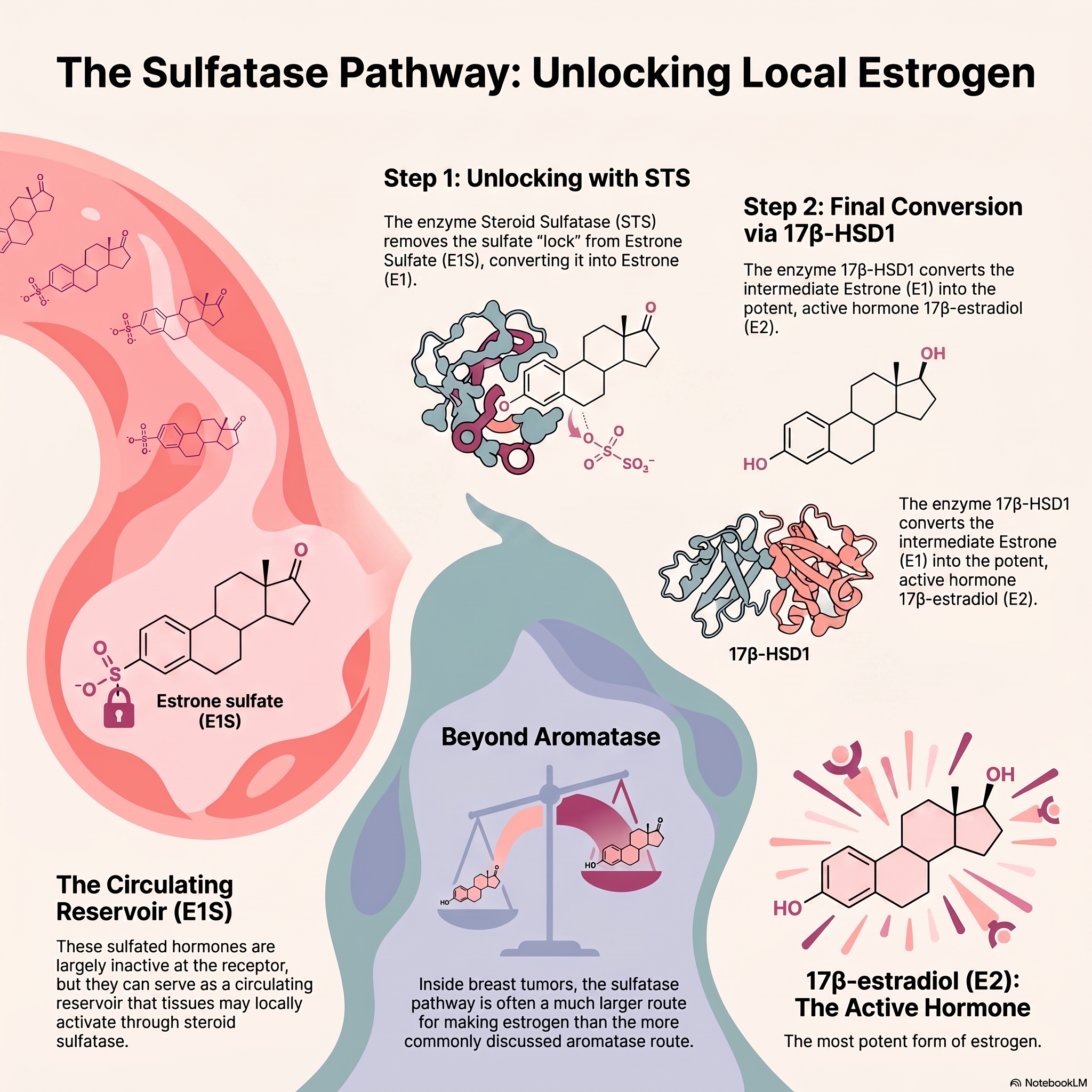
But inside the breast, and especially inside breast tumors, there is a second, often much larger route for making estrogen. It is called the sulfatase pathway.
Your bloodstream carries a huge storage pool of hormones in a locked, sulfate form: estrone sulfate (E1S) and DHEA sulfate (DHEA-S) [4, 5]. These look “inactive” on a lab report. But they are ready to use if a cell has the right key. That key is an enzyme called steroid sulfatase, or STS. STS removes the sulfate lock, thereby freeing up estrone (E1) and DHEA. Once estrone is released, another enzyme called 17β‑HSD1 acts like a pro‑estradiol switch, converting estrone into estradiol (E2), the more powerful estrogen signal in that tissue. [4, 5].
Here is something rarely discussed in breast cancer conversations. In many breast tumors, this STS route is far more active than aromatase. One major review found that sulfatase activity in breast cancer can exceed aromatase by 50 to 200 times [5]. Local estradiol inside tumor tissue can run more than 20 times higher than blood levels, especially after menopause (or during ovarian suppression), because the tumor is making its own estrogen on site [4, 5].
So when we focus only on aromatase, we are often staring at the smaller hose and ignoring the much larger pipeline.
What happens when we block and block and block
We are told this is a straightforward success story: less estrogen, less recurrence. The lived reality is messier.
Around 30% of ER-positive breast cancers show primary endocrine resistance. They do not respond to hormone-blocking therapy from the start [6, 7].
Many others develop resistance over time. And as we clamp down harder, the biology adapts. Tumors turn up STS and 17β-HSD1, leaning on the sulfatase pathway to rebuild estradiol locally [4]. They activate alternative growth pathways to bypass a blocked receptor [6, 7].
To me, this is not just “tumor sneakiness.” It is a loud message: estrogen signaling is important enough that cells will build brand-new roads to get it back.
A Norwegian clue: when more STS meant less cancer spread
In 2018, McNamara and colleagues looked at 139 breast cancers from Norway and asked a simple question: What happens to outcomes when tumors make different amounts of these estrogen-handling enzymes [8]?
They measured three enzymes inside the tumors: steroid sulfatase (STS), 17β‑HSD2, and aromatase. STS is the enzyme that unlocks stored estrogen from its sulfate form, while 17β‑HSD2 does the opposite of estrogen‑activating enzymes like 17β‑HSD1 by converting potent estradiol (E2) back into the weaker estrone (E1). After measuring these, they followed the women over time to see who developed local recurrences, distant metastases, and how long they survived overall [8].
Here is what they found about STS
About 59% of the tumors were STS-positive. Compared with STS-negative tumors, the STS-positive tumors had less local recurrence, less distant spread, and better overall survival [8]. The authors concluded that more estrogen processing through STS was linked to significantly fewer relapses and better prognosis [8].
Now put that next to what they saw with 17β‑HSD2, the enzyme that pulls potent estrogen out of circulation by converting estradiol (E2) back into weaker estrone (E1). It showed almost the opposite pattern, tending toward a higher risk of recurrence and metastasis. [8].
Read those findings together. When a tumor makes more 17β‑HSD2, it is stripping more of the strong, active estrogen signal out of the tissue. On the old model, you would expect that to be good news: less strong estrogen should mean less cancer, right?
That is not what happened. In this group, the more of this estrogen‑removing enzyme a tumor produced, the more likely it was to come back and spread. When the potent estrogen was taken away, outcomes got worse, not better.
How this fits with Dr. Suba’s “estrogen as guardian” model
Dr. Zsuzsanna Suba has argued for years that the real problem in breast cancer is defective estrogen signaling, not simply “too much estrogen” [9, 10].
In her model, estrogen signaling supports DNA damage repair, works alongside BRCA and other tumor-suppressor pathways to protect the genome, and helps keep mitochondria and energy balance healthy [1, 2, 3]. When we block or cripple that signaling, we injure a core genome-stabilizing circuit, and the cell shifts into a kind of emergency mode, turning up the receptor, STS, and growth pathways to try to restore the signal [9, 10].
Seen this way, the Norwegian data make sense. STS-positive tumors are better at pulling estrogen from that huge sulfate reserve, and in this group, they relapsed less, spread less, and survived better [5, 8]. That is exactly what you would expect if restoring estrogen signaling helps keep leftover cancer cells more orderly and less aggressive.
Meanwhile, the enzyme that removes potent estrogen tracked toward worse outcomes, which echoes Suba’s warning that chronic estrogen depletion can worsen genomic chaos rather than prevent it [8, 9]. I am not offering a final answer here. Science does not work that way. But the pattern is hard to ignore.
Rethinking our goal: restore signaling, not annihilate it
All of this leaves me with a very different goal than “estrogen zero.”
The goal I keep landing on is to restore proper estrogen signaling. Not estrogen everywhere, in any form, at any dose. Balanced, physiologic signaling through healthy receptors, in a body with working DNA repair and healthy mitochondria as much as a woman’s biology allows [1, 2, 3].
That means honoring the whole hormone symphony, not one instrument.
Here is how I think about it:
Estradiol and estriol are the core estrogen signals for the brain, bone, blood vessels, and DNA repair.·
Progesterone to balance growth and keep things stable.·
Testosterone for androgen signaling, muscle, and cognition, with thoughtful attention to how it converts.·
Metabolic health as the soil underneath all of it, so that insulin, glucose, and inflammation are not dialing up tumor growth pathways, or quietly damaging DNA and mitochondria in the first place [11, 12].
In that light, the tumor turning up STS looks less like mischief and more like a desperate attempt to restore a broken network.
And I want to be honest about the cost of chronic blockade. I do not believe indefinite, aggressive estrogen blockade is neutral. It may have a narrow window of benefit for a small number of very high-risk women, for a limited time. Beyond that, it carries a real cost to bone, brain, heart, metabolic health, mitochondrial resilience, and genome stability itself.
The fact that nearly every woman on endocrine therapy is eventually expected to develop resistance should not be shrugged off as “just how cancer works.” To me, it is a sign that biology does not tolerate the total collapse of estrogen signaling forever [6, 7].
What this means, and does not mean, for you
If you are a woman with breast cancer reading this, I am not telling you to stop your endocrine therapy or ignore your oncology team. I am inviting you to ask better questions.
Ask about the sulfatase pathway, not just aromatase [5, 8].
Ask about your absolute risk reduction from therapy, not only the relative percentages.
Ask how your team is supporting your metabolic health, your mitochondria, and your overall hormone environment while you are on these drugs [11, 12].
And here is the bigger picture I keep coming back to. Maybe estrogen is not the villain. Maybe the real problem is broken signaling in a metabolically stressed body, and the tumor’s move to turn up sulfatase is biology’s imperfect way of trying to turn the lights back on.
Survival matters. Of course it does. But so does understanding what estrogen is actually doing in the body while we fight the cancer. Those are not competing goals. They are both part of good medicine. And the fact that you are here, reading this and asking these questions, matters more than you know.
Want to learn more?
This piece is the deeper dive behind my companion post, The Minority Benefit: Why Hormone Blockers Help Some Women but Fail Many, which walks through the three ways cancer cells find estrogen after the drugs try to take it away.
Other articles include: Hormones & Breast Cancer: What’s Fact, What’s Fiction?, The History of Breast Cancer Treatments and the Misguided War on Estrogen, The Truth About Estrogen, Breast Cancer, and Hormone Therapy: What the Latest Research Reveals
Download the Balance App to access Breast Cancer: Your Complete Guide·
Grab my Beginner’s Guide to HRT if you are just starting to sort through the hormone conversation.·
Explore my FREE resources, plus more than 40 educational videos and nearly 350 real questionsanswered from the women in my former online community, Pausing Together.
Disclaimer: This article is for educational and informational purposes only and is not intended to replace personalized medical advice or individualized care. It is meant to help you understand your physiology, explore evidence-based options, and make informed choices about your health and wellness. Healthcare should be a partnership, not a permission slip, and proactive care is just as essential as treatment. Use this information to engage in open, collaborative discussions with your provider or to make empowered decisions that align with your own values, goals, and comfort level. You are the ultimate authority on your body.
References
1. Klinge, C. (2020). Estrogenic control of mitochondrial function. Redox Biology, 31, 101435. https://doi.org/10.1016/j.redox.2020.101435
2. Suba, Z. (2024). Estrogen regulated genes compel apoptosis in breast cancer cells, whilst stimulate antitumor activity in peritumoral immune cells in a Janus-faced manner. Current Oncology, 31(9), 4885-4907. https://doi.org/10.3390/curroncol31090362
3. Suba, Z. (2025). Human cancers derived from either genetic or lifestyle factors are initiated by impaired estrogen signaling. Cancers, 18(1), 78. https://doi.org/10.3390/cancers18010078
4. Secky, L., et al. (2013). The sulfatase pathway for estrogen formation: targets for the treatment and diagnosis of hormone-associated tumors. Journal of Drug Delivery, 2013, 957605. https://doi.org/10.1155/2013/957605
5. Foster, P. (2021). Steroid sulphatase and its inhibitors: past, present, and future. Molecules, 26(10), 2852. https://doi.org/10.3390/molecules26102852
6. Szostakowska, M., et al. (2018). Resistance to endocrine therapy in breast cancer: molecular mechanisms and future goals. Breast Cancer Research and Treatment, 173(3), 489-497. https://doi.org/10.1007/s10549-018-5023-4
7. Mills, J., et al. (2018). Mechanisms of resistance in estrogen receptor positive breast cancer: overcoming resistance to tamoxifen/aromatase inhibitors. Current Opinion in Pharmacology, 41, 59-65. https://doi.org/10.1016/j.coph.2018.04.009
8. McNamara, K., et al. (2018). In breast cancer subtypes steroid sulfatase (STS) is associated with less aggressive tumour characteristics. British Journal of Cancer, 118(9), 1208-1216. https://doi.org/10.1038/s41416-018-0034-9
9. Suba, Z. (2015). The pitfall of the transient, inconsistent anticancer capacity of antiestrogens and the mechanism of apparent antiestrogen resistance. Drug Design, Development and Therapy, 9, 4341-4353. https://doi.org/10.2147/DDDT.S89536
10. Suba, Z. (2023). Rosetta Stone for cancer cure: comparison of the anticancer capacity of endogenous estrogens, synthetic estrogens and antiestrogens. Oncology Reviews, 17, 10708. https://pubmed.ncbi.nlm.nih.gov/37152665/
11. Key, T., et al. (2010). Insulin-like growth factor 1 (IGF1), IGF binding protein 3 (IGFBP3), and breast cancer risk: pooled individual data analysis of 17 prospective studies. The Lancet Oncology, 11(6), 530-542. https://doi.org/10.1016/S1470-2045(10)70095-4
12. Seyfried, T., & Shelton, L. (2010). Cancer as a metabolic disease. Nutrition & Metabolism, 7, 7. https://doi.org/10.1186/1743-7075-7-7